

Dive into the data of the 2026 Midwest Conservation Blueprint
The Midwest Conservation Blueprint is a living spatial plan, and thus a continual work in progress. It is regularly updated utilizing a rapid prototyping framework that allows us to respond to partner priorities, incorporate input from blueprint users, and ensure the use of the best available science.
The 2026 version of the blueprint is no different, incorporating feedback from many partners, leading to improvements such as data additions and methodological updates. In total, we incorporated minor changes or updates to 11 data layers and added five totally new sets of data. Below, we’ll explore a few of our biggest upgrades this year: the addition of three new data products.
Regional Species of Greatest Conservation Need
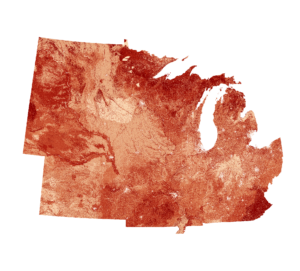
Across the U.S., each state identifies Species of Greatest Conservation Need (SGCN) in their State Wildlife Action Plans (SWAPs). Midwest Regional Species of Greatest Conservation Need (RSGCN) are species identified as SGCN that will benefit from assessment and management at a regional scale due to their significance, responsibility, and high concern in the Midwest.
To represent Midwest RSGCN in the blueprint, we incorporated data on terrestrial, vertebrate RSGCN from the USGS Gap Analysis Project. Pixel values of this layer correspond to the rarity-weighted richness of RSGCN, meaning areas containing rare or range-limited species are weighted more highly.
With improved representation of RSGCN in the blueprint, users can more easily target proactive conservation to areas that may benefit greater numbers of at-risk species, aiding in the goal of keeping them from becoming federally threatened or endangered. Future plans for this indicator include the addition of data for other species groups such as invertebrates and aquatic species.
Game Species
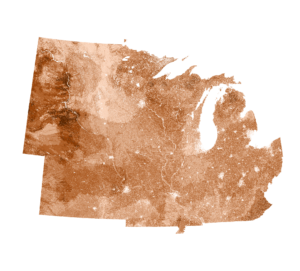
Time spent hunting is a treasured tradition for many across the Midwest region, allowing people the opportunity to connect with the land and receive sustenance from locally sourced food. It is also one of the major activities that funds the conservation of our lands, waters, and wildlife.
The addition of a game species data layer allows us to spatially represent this activity in the blueprint. Pixel values of this layer correspond to the species richness of fourteen commonly-hunted species listed in the National Survey of Fishing, Hunting, and Wildlife-Associated Recreation: white-tailed deer, black bear, Rocky Mountain elk, moose, mule deer, pronghorn, wild turkey, bobwhite quail, ring-necked pheasant, American woodcock, ruffed grouse, sharp-tailed grouse, greater prairie chicken, and mourning dove.
This layer is the first step in planned improvements to the representation of culturally important species in the blueprint. We hope to add further data on other species groups such as waterfowl, fish, and plants in the future.
Natural Resource Economics
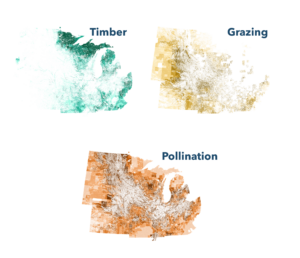
Careful stewardship of our natural resources is a crucial economic driver for many Midwest communities. Three activities resulting from that stewardship with widespread economic impacts in the region include timber harvesting, grazing, and pollination of agricultural areas.
Three data layers were incorporated into this year’s blueprint update, representing the monetary value of these activities by county. Multiple data sources were incorporated, including Cavender-Bares et al. 2022, Jordan et al. 2021, Koh et al. 2015, and products from the USDA’s National Agricultural Statistics Service.
Including this data allows blueprint users to visualize how valuable natural resources are to the people and economies of Midwest communities. We hope to add further data on the widespread outdoor recreation and tourism economies in the region.
Accessing Blueprint Data
These layers, plus all other input data layers for the Midwest Conservation Blueprint, can be accessed on our online data portal.